

The 2026 Shift North: Staffing Industrial Growth Beyond the GTA
Why are GTA industrial companies expanding north of Toronto?
By mid-2026, the math of staying inside the core GTA industrial market has gotten harder. Available space is scarce, and even with a recent softening, occupancy costs in Peel and York remain elevated. For some manufacturers and distributors, the more affordable land and rents up Highway 400 — into Barrie, Bradford, and the wider Simcoe County market — have started to look like a practical alternative, especially for warehousing and distribution that doesn't need to sit in the urban core.
- 5.1% GTA industrial vacancy — an 11-year high in Q1 2026, though the rate of increase has slowed sharply, suggesting the correction is near its floor.
- ~$16.49/SF average net rent — GTA-wide, with Vaughan and Brampton space frequently at $18+ PSF.
- ~$13–16/SF Barrie-area net rents — stabilized in a lower band than York and Peel, a core reason operators are evaluating a northern footprint.
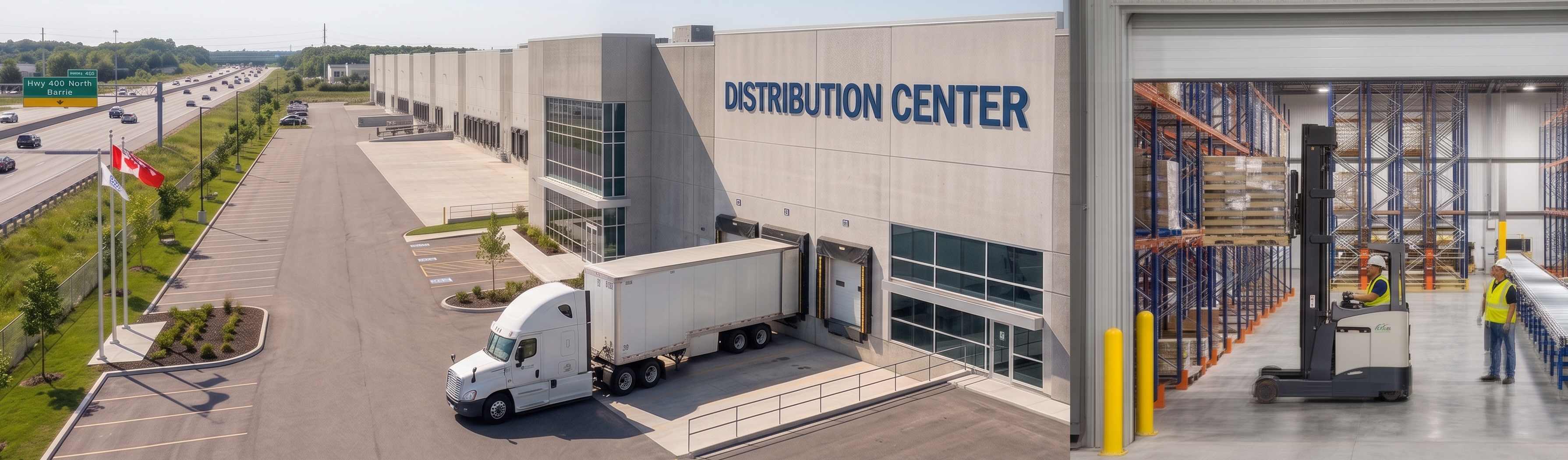
The northern corridor's appeal isn't only about price. New large-format industrial space has been built along Highway 400 — including a 236,000+ SF distribution building on Mapleview Drive West in south Barrie and the multi-building Park Place business campus — giving incoming operators modern, high-clear-height options near the highway. And there's a labour story underneath the real estate one: Barrie and Simcoe County have a substantial industrial workforce, and local unemployment has sat among the higher rates of Canadian cities through early 2026, which generally means more available local talent for employers setting up in the region.
What changes when your supply chain crosses into Simcoe County?
Moving north trims rent, but it adds logistics and operational considerations. Beyond the edge of North York and Scarborough, transport schedules back to GTA hubs and customers get longer, and Highway 400 congestion and road-widening work can make travel times less predictable. Planning routes around construction zones and building in schedule flexibility becomes part of running the facility well.
One of the larger infrastructure changes is already in motion. The Province officially began major construction on the Bradford Bypass — now designated Highway 425 — in May 2026, breaking ground on the west section near Highway 400. Once complete, the roughly 16.3-kilometre, four-lane highway will link Highway 400 in the west to Highway 404 in the east, which the Province expects to ease east-west truck movement and shorten travel times across the area. In the near term, though, that same work means active construction zones and detours to plan around. Local economic development groups such as Invest Barrie continue to promote the region's transportation and workforce advantages, but each incoming operator still has to solve its own local logistics and staffing on the ground.
- Highway 425 (Bradford Bypass) — major construction began on the west section in May 2026, connecting Highway 400 and Highway 404.
- ~16.3 km, four lanes — built to relieve east-west congestion and improve goods movement across York Region and Simcoe County.
How do you keep a northern facility staffed without overloading HR?
Opening or expanding to a second site an hour north puts real weight on an HR team that's used to hiring close to home. Recruiting in an unfamiliar local market, vetting candidates remotely, and managing onboarding and compliance at a distance can pull a team away from the strategic hiring that actually grows the business.
This is the burden Alliance is built to take off your plate. We use one regional network that spans the GTA and the Highway 400 corridor, so you can hold the same hiring standard whether the shift is in Mississauga or Innisfil. Across the GTA and northward, our recruiters are seeing:
- More available local labour up north: with Barrie-area unemployment running relatively high through early 2026, the candidate pool for industrial roles has been comparatively deep.
- Manufacturing churn: tariff pressure on Ontario manufacturing has freed up experienced operators and warehouse staff who are open to new local roles.
- Tighter timelines: employers want a new site producing quickly, which puts a premium on fast deployment rather than a months-long local hiring build-out.
As Employer of Record, Alliance administers payroll, WSIB claims management, and Ontario ESA compliance for the workers we place — designed to reduce the administrative load on your internal team, province-wide.
Tap our network of pre-vetted industrial and manufacturing workers in the Barrie and Bradford areas. If local hiring is still ramping, we can deploy additional personnel from other regions to keep operations supported.
With hiring, payroll, and compliance administration handled for your new northern location, your core team can focus on getting the facility running and on strategic growth.
Frequently Asked Questions: Navigating Regional Industrial Shifts
How does Alliance help GTA businesses expanding outside the main city area?
Alliance maintains a recruiting network across the GTA and surrounding regions, including the Highway 400 corridor north of the city. When a business opens a facility in Barrie or Innisfil, we manage local hiring and on-site coordination so your hiring standards stay consistent with what you expect in Vaughan or Brampton. If local recruitment is still ramping up, we can mobilize qualified personnel from our broader regional network to keep operations supported.
Does moving to Simcoe County change our legal or safety responsibilities?
A new location can introduce different site-safety considerations and transport-related risks, though Ontario's Employment Standards Act and WSIB framework apply province-wide. When you engage Alliance as your Employer of Record, we take on payroll, WSIB claims management, and ESA compliance administration for the workers we place, which is designed to reduce the administrative and compliance load on your internal HR team. This is not a substitute for your own site health-and-safety program, and arrangements should be confirmed for your specific situation.
Can Alliance find skilled technical workers for new northern facilities?
Yes. Barrie and Simcoe County have a sizable industrial and manufacturing workforce, and local labour availability has been relatively strong. We recruit machine operators, forklift-certified staff, shipping and receiving personnel, and general industrial labour, and can source more specialized roles based on each facility's requirements.
How do you keep staffing levels stable if local hiring is still in progress?
If local recruitment is still ongoing, we can mobilize qualified personnel from our broader regional network to help maintain operational continuity while we build out the local roster. Our model is built for fast deployment, so a new or seasonal facility can keep running while permanent local hiring catches up.
Is the Highway 400 corridor actually cheaper than staying in Peel or York?
Industrial real estate costs are generally lower north of the GTA. As of early 2026, GTA industrial net rents averaged roughly $16.49 per square foot, with Vaughan and Brampton space frequently running $18+ PSF, while Barrie-area net rents have stabilized in the lower-to-mid $13 to $16 PSF range according to market reports. Lower occupancy cost is a key reason some operators are evaluating a northern footprint, though longer transport distances back to GTA hubs need to be weighed against the savings.
Expanding North? Keep Every Shift Covered.
From Mississauga to Simcoe County, Alliance keeps your facilities staffed and your compliance load light — so growth doesn't come at the cost of your standards.
Book a Free Staffing Consultation Or call directly: (416) 892-6715 · Fast, same-day deployment · No long-term commitment